
My SZN Guide · Wellness · 🍂 Autumn
Stretches for Beginners at Home: Where to Start
A full-body sequence for people who describe themselves as 'not flexible', and what actually changes.
Guide · free · 15 minutes · 7 min read
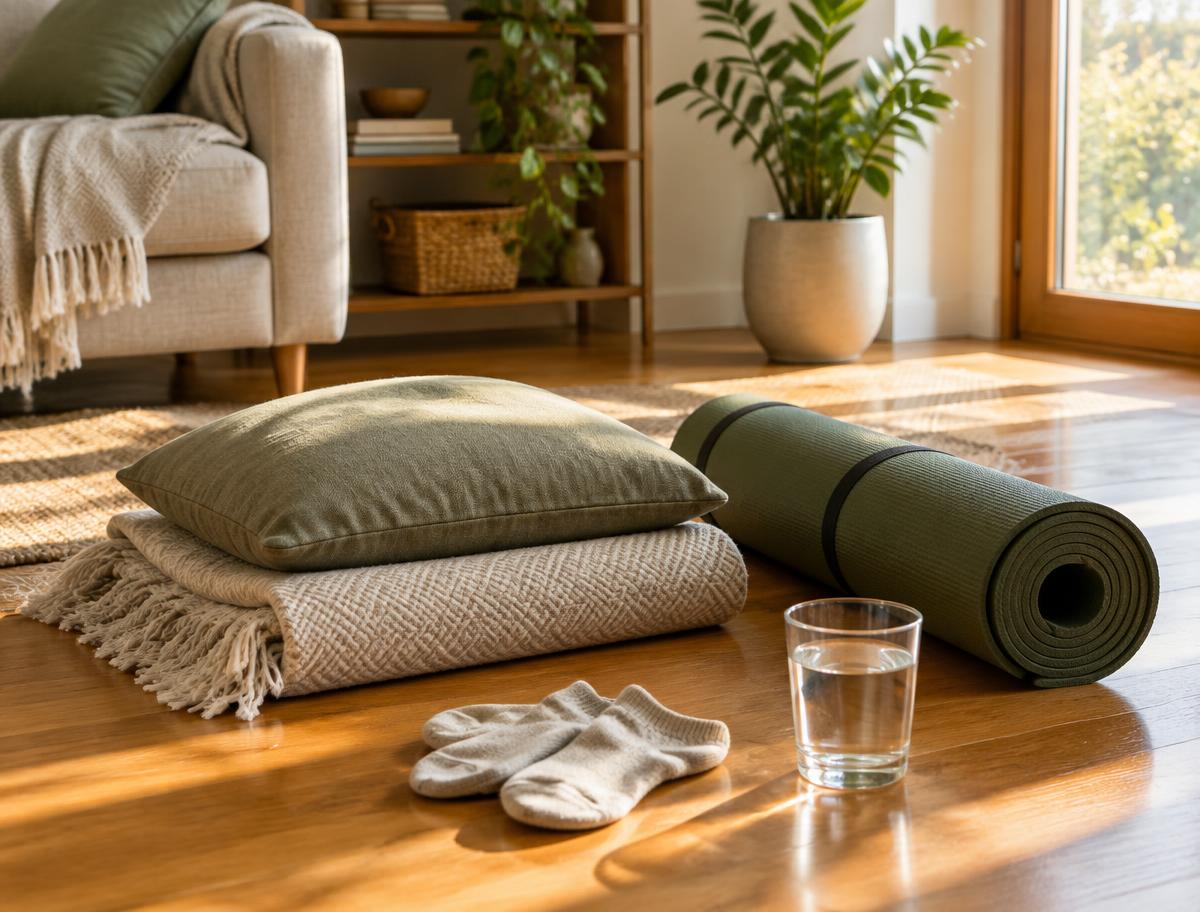
"I'm not flexible" is almost always a description of where someone is starting, not a fixed fact about their body.
This is the starting sequence: eight stretches covering the whole body, held long enough to be worth doing, with nothing that requires getting into a shape you've seen on the internet.
How long to hold, and how often
Somewhere between 20 and 45 seconds per stretch is the usual working range, repeated two or three times a week. Longer is not automatically better, and bouncing at the end of the range is the one thing worth avoiding.
Regularity does more than duration. Three fifteen-minute sessions beat one long Sunday effort, and they're much easier to fit into a week that has other things in it.
A full-body beginner sequence
- Neck: ear gently towards shoulder, hand resting on the head with no pull. 30 seconds each side.
- Chest: forearm on a door frame, step through slowly. 30 seconds each side.
- Upper back: clasp hands in front, round the back and push the hands away. 30 seconds.
- Side body: reach one arm overhead and lean, keeping both feet planted. 30 seconds each side.
- Hip flexors: half-kneeling lunge, tuck the tailbone slightly before you lean. 40 seconds each side.
- Hamstrings: one heel forward, hinge from the hips with a long back, soft knee. 40 seconds each side.
- Glutes: seated on a chair, ankle on the opposite knee, lean forward with a straight back. 40 seconds each side.
- Calves: hands on the wall, back leg straight, heel down. 30 seconds each side.
The mistakes that put beginners off
- Going for the deepest version on day one. The mild version repeated does more than the dramatic version abandoned.
- Holding your breath. If you can't talk, you've gone too far.
- Stretching a muscle that's genuinely sore from an injury rather than from ordinary use.
- Comparing your hamstrings to someone else's. Range varies hugely between people and always will.
- Only stretching the bits that already move well — usually the front of the body, rarely the hips.
Sensible caution
General wellbeing information, not medical advice. Stop anything sharp or painful. If you're pregnant, post-natal, recovering from injury or surgery, or living with a joint or nerve condition, ask a GP or physiotherapist what's suitable before starting.
Keep it for this SZN
- Stretch for 15 minutesThe full-body beginner sequence, two or three times a week.⏱️ 15 minutes📶 Beginner🧺 A mat or carpet and a wallKept for later 🤎
- Do the chair version of the sequenceFor days when getting down to the floor isn't happening.⏱️ 8 minutes📶 Gentle🧺 A sturdy chairKept for later 🤎
Anything you keep lands in My Keeps — ready to plan, live and remember.
Questions people ask
- How often should a beginner stretch?
- Two or three sessions a week is a realistic starting point, and daily short sessions are fine if they stay gentle. Consistency matters more than length.
- Can I stretch every day?
- Gentle daily stretching suits most people. If something feels persistently sore rather than pleasantly worked, give it a day and ask a physiotherapist if it continues.
- Do I need any equipment?
- No. A carpet, a wall and a chair cover everything here. A mat is more comfortable, and a strap or belt can help with hamstrings, but neither is necessary to start.
Sources
My SZN editorial. Opening times, prices and local conditions change — always check with the place you're visiting before you travel.
More My SZN Guides
My SZN Guide · Wellness
A 10 Minute Morning Stretch Routine You'll Actually Do
Eight movements, no equipment, done before the kettle has boiled.
6 min read
My SZN Guide · Wellness
Desk Stretches: Five Minutes That Change an Afternoon
What to do at 11 and at 3, without leaving your chair or explaining yourself to anyone.
5 min read
My SZN Guide · Wellness
An Evening Mobility Routine for the End of a Long Day
Twelve minutes on the floor with the lamp on, somewhere between exercise and switching off.
6 min read